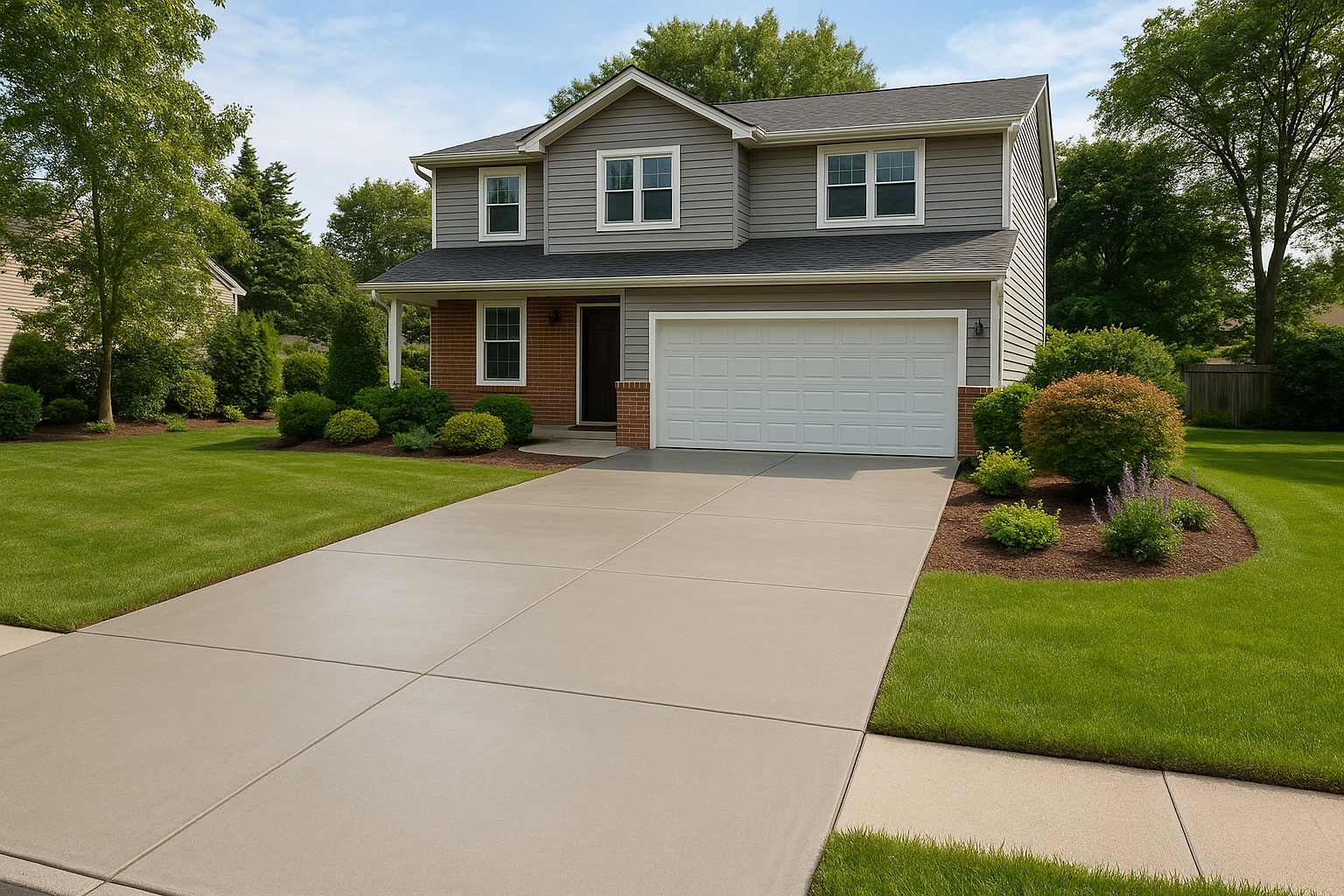
Knowing the concrete area of a patio, driveway, floor, or walkway is the first step toward planning a successful project. An accurate area measurement helps you estimate material needs, compare contractor quotes, and avoid costly ordering mistakes. It also gives you a useful starting point for calculating how much concrete to buy.
Concrete area is usually measured in square feet or square meters. Because concrete is placed at a certain thickness, however, area alone does not tell you how much concrete the project requires. You will also need to know the planned depth. This guide explains how to measure concrete area, work with different shapes, and turn your measurements into an order estimate.
What Does Concrete Area Mean?
Concrete area is the surface space that will be covered by a concrete slab or other flatwork. For a rectangular slab, it is the length multiplied by the width. The result is expressed in square units, such as square feet (sq. ft.) or square meters (m²).
Area is different from volume. Area describes the slab’s footprint, while volume describes the amount of space the concrete fills. Volume depends on both the area and the slab thickness. For example, two patios can have the same area but require different amounts of concrete if one is thicker than the other.
How to Measure Concrete Area
Measure a rectangular or square space
Measure the length and width of the area in the same unit. Multiply the two measurements:
Area = length × width
If a patio is 12 feet long and 10 feet wide, its area is 12 × 10, or 120 square feet. For a square space, measure one side and multiply it by itself. A 9-foot-square pad has an area of 9 × 9, or 81 square feet.
Break irregular shapes into sections
Not every concrete project has a simple outline. An L-shaped patio, for example, can be divided into two rectangles. Find the area of each rectangle separately, then add the results. For curved or angled sections, divide the outline into familiar shapes where possible and use the appropriate formula for each one.
For a circular pad, measure the distance from the center to the edge to find the radius. Then use:
Area of a circle = π × radius²
A circle with a 4-foot radius has an area of about 50.3 square feet. If a shape is especially irregular, consider measuring it on a scaled drawing or asking a concrete contractor to verify the dimensions before ordering.
Keep units consistent
Do not multiply feet by inches or meters by centimeters without converting first. If a measurement is given in inches, divide by 12 to convert it to feet. To convert square feet to square yards, divide by 9. To convert square feet to square meters, multiply by approximately 0.0929. Write down the unit beside each measurement so it is easy to spot a mismatch.
Calculate the Concrete Volume
Once you know the area, multiply it by the slab thickness to find the volume. The thickness must be in the same unit as the other dimensions. For a project measured in feet, convert inches to feet by dividing by 12.
Volume in cubic feet = area in square feet × thickness in feet
For example, a 120-square-foot patio that is 4 inches thick has a thickness of 4 ÷ 12, or about 0.333 feet. Its volume is 120 × 0.333, or approximately 40 cubic feet. Concrete is commonly ordered by the cubic yard, so divide cubic feet by 27. In this example, 40 ÷ 27 is about 1.48 cubic yards.
For square meters and thickness in meters, the same principle applies: multiply area by thickness to get cubic meters. Check the supplier’s preferred ordering units before placing an order.
Plan for Edges, Openings, and Waste
Measure the actual area that will receive concrete. If the project includes a gap, planter opening, or existing structure that will not be covered, subtract its area from the total. For a large opening, measure and calculate it as a separate shape. Small features may not be worth subtracting if the difference is minor, but consistency helps keep your estimate clear.
It is also wise to allow for a modest extra amount. The ground may be uneven, forms can shift, and some concrete can be lost during placement. Many projects include a buffer of roughly 5 to 10 percent, depending on site conditions and how precise the measurements are. Avoid adding a large cushion automatically: excess concrete can be difficult and expensive to handle.
Common Concrete Area Measuring Mistakes
- Measuring only once: Check each dimension again, especially on long or uneven edges.
- Assuming the outline is square: Compare opposite sides and measure diagonals when needed to check whether corners are square.
- Forgetting slab thickness: Area is not enough to estimate the concrete order; volume requires depth.
- Mixing measurement units: Convert all dimensions to one unit before calculating.
- Ignoring site conditions: Slopes, soft ground, and varying depth can change how much concrete the project needs.
For a structural slab, a large pour, or a project with unusual ground conditions, confirm the required thickness and reinforcement with a qualified professional. Local building requirements and the intended use of the slab can affect the design.
Conclusion
To find concrete area, measure the space, divide irregular outlines into manageable shapes, and calculate each section in consistent units. Then use the planned thickness to estimate concrete volume, adding a reasonable allowance for site conditions. Careful measurements make budgeting and ordering easier—and help your project get off to a solid start.