What Is Concrete Area?
When people talk about concrete area, they usually mean the total surface space that needs to be covered with concrete. This might be a driveway, patio, sidewalk, slab, garage floor, or foundation pad. Knowing the concrete area is the first step in estimating how much concrete you need, planning a project, and budgeting accurately.
In simple terms, concrete area is measured in square units such as square feet or square meters. Once you know the area, you can determine the volume of concrete required by multiplying the area by the thickness of the slab. That makes area the foundation of every successful concrete project.
Why Concrete Area Matters
Calculating concrete area correctly helps you avoid costly mistakes. If you underestimate, you may run short of material, which can delay the job and create uneven results. If you overestimate, you may waste money on extra concrete that is not needed.
Accurate area calculations also help with:
- Estimating material costs
- Planning truck deliveries or mixer loads
- Comparing contractor quotes
- Preparing forms and layout lines
- Reducing waste and improving efficiency
Whether you are pouring a small garden path or a large slab, understanding concrete area makes the project easier to manage from start to finish.
How to Measure Concrete Area
Measuring concrete area is straightforward when the shape is simple. For most rectangular or square spaces, use the basic formula:
Length × Width = Area
For example, if a patio is 12 feet long and 10 feet wide, the area is 120 square feet.
For irregular shapes, break the space into smaller sections, calculate each section separately, and then add the totals together. You can also use shapes like triangles and circles when needed:
- Rectangle: length × width
- Triangle: 0.5 × base × height
- Circle: 3.14 × radius²
Take your measurements carefully, and measure twice if possible. Even small mistakes can affect the final amount of concrete needed.
Tools You Can Use
You do not need specialized equipment to measure concrete area. A tape measure, notepad, and calculator are usually enough. For larger spaces, a laser measure can make the process faster and more precise. Graph paper or a sketch of the project area can also help you stay organized.
How to Convert Concrete Area Into Concrete Volume
Area alone does not tell you how much concrete to buy. You also need thickness, because concrete is measured by volume. The basic formula is:
Area × Thickness = Volume
For example, a slab that is 120 square feet and 4 inches thick requires more concrete than the same slab at 3 inches thick. To use this formula correctly, convert thickness into the same unit system as the area. In the United States, thickness is often measured in inches while area is measured in square feet, so a conversion is needed.
Here is a simple example:
- Area: 120 square feet
- Thickness: 4 inches, or 0.333 feet
- Volume: 120 × 0.333 = 40 cubic feet
Since concrete is often sold by cubic yards, divide cubic feet by 27 to convert:
40 ÷ 27 = 1.48 cubic yards
In real projects, it is wise to order a little extra to account for spillage, uneven subgrade, and minor measuring differences.
Common Concrete Area Examples
Concrete area can apply to many different projects around a home or business. Here are a few common examples:
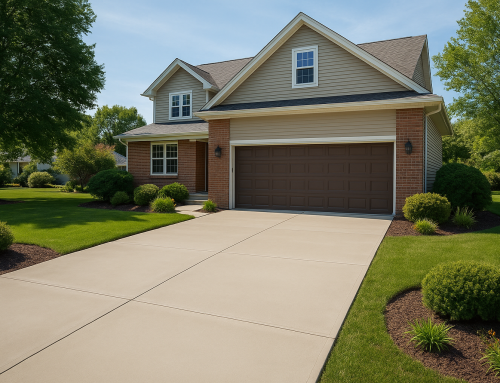
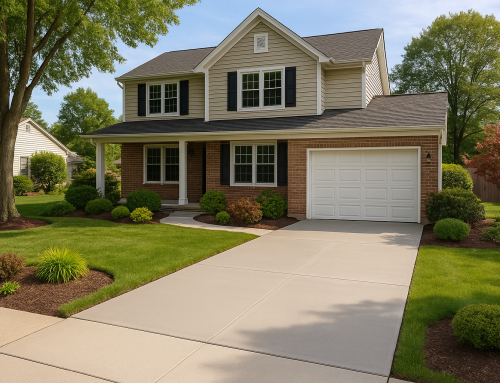
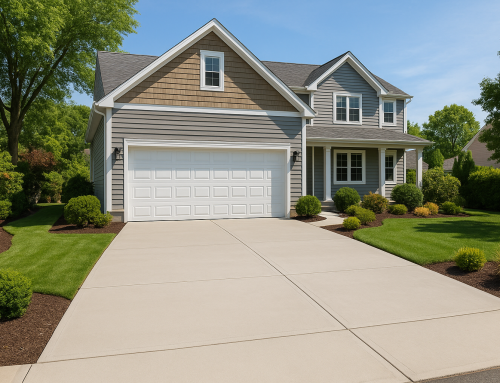
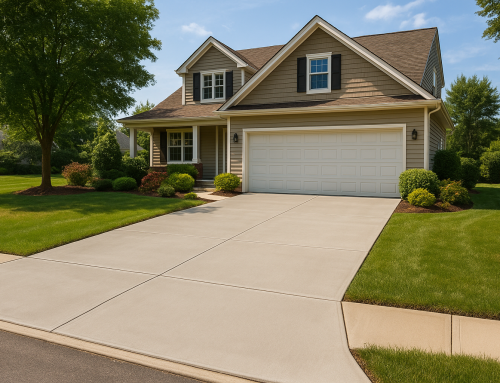
- Driveways: Often measured in long rectangles or multiple connected sections
- Patios: Usually simple squares, rectangles, or custom shapes
- Sidewalks: Long, narrow strips that may include curves or corners
- Garage floors: Typically rectangular, but may include expansion joints or cutouts
- Foundation slabs: Require precise measurement because structural performance depends on accuracy
Each of these projects begins with the same basic question: how much surface area needs to be covered? Once that is answered, the rest of the planning process becomes much easier.
Tips for Accurate Concrete Area Calculations
Even though the math is simple, there are a few practical tips that can improve accuracy and save time.
- Draw a scale sketch: A simple diagram helps you visualize the project and avoid missing sections.
- Measure every section: Do not assume all sides are equal unless you have verified them.
- Account for curves and cutouts: Non-rectangular areas need special attention.
- Check thickness requirements: Different projects may need different slab depths.
- Add a waste factor: Ordering 5% to 10% extra is common for many concrete jobs.
If you are working on a larger project, it may also help to confirm your measurements with a contractor or supplier before placing an order.
Using Concrete Area in Project Planning
Once you know the concrete area, you can use it to build a more complete project plan. The area affects how much material you need, how long the pour may take, and what kind of crew or equipment is required.
For example, a small concrete area for a walkway may be manageable with hand mixing, while a larger driveway or slab may require a ready-mix truck. Area also influences reinforcement needs, finishing time, and curing expectations.
It is helpful to think of area as the starting point for every other calculation. From there, you can estimate concrete volume, reinforcement mesh, forms, labor, and finishing supplies. Better planning usually leads to better results and fewer surprises.
Conclusion
Understanding concrete area is one of the simplest ways to make any concrete project more successful. With a few basic measurements and some simple math, you can estimate materials more accurately, reduce waste, and plan with confidence. Whether you are pouring a small slab or a larger surface, getting the area right sets the stage for a smoother project from beginning to end.